
13 July 2026 · 3 min read
How Does a Pivot Door Work?
A pivot door turns on its own axis via a pivot hinge. Learn how it differs from a classic hinge, how the weight is distributed and what the system is made of.
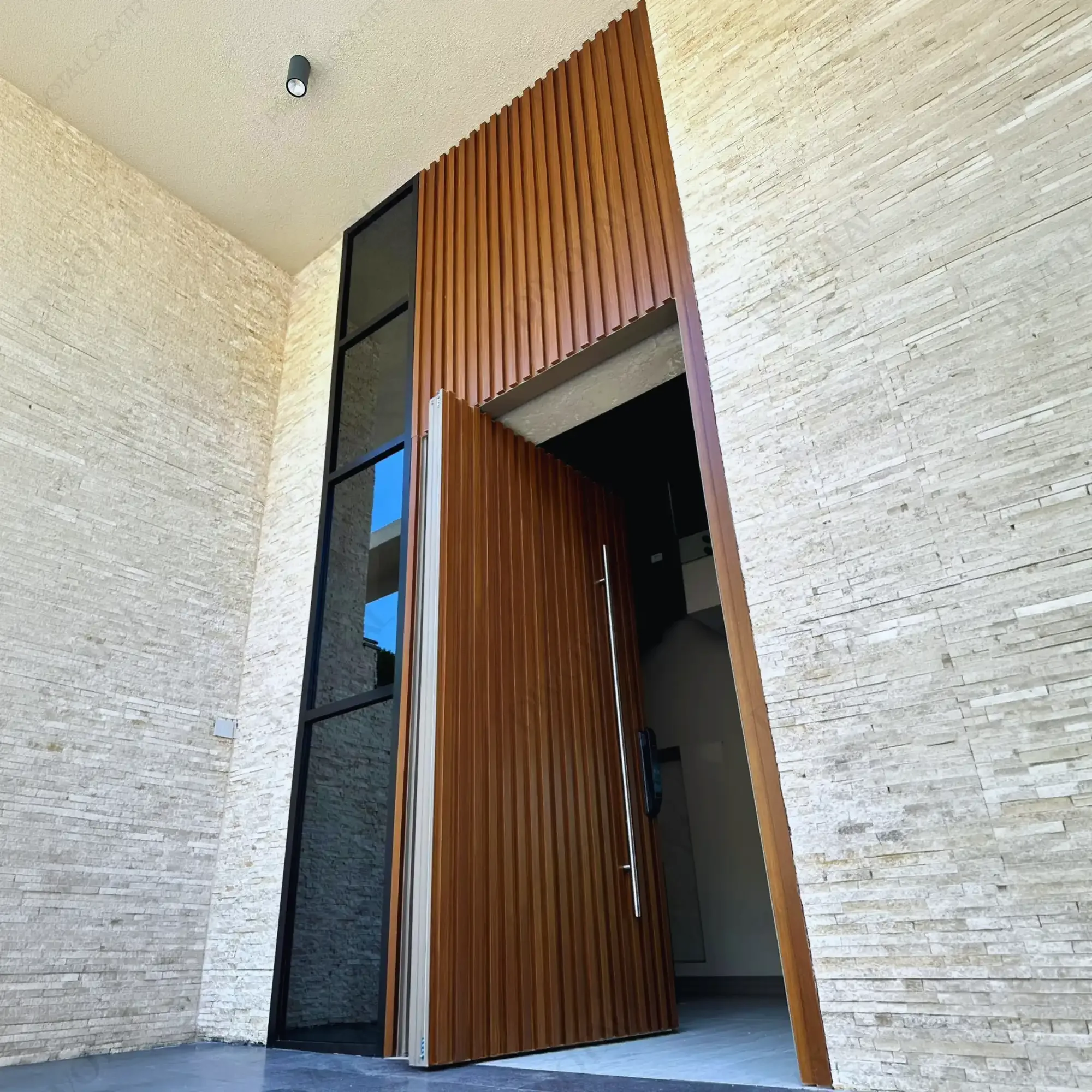
A pivot door works on a completely different principle from classic hinged doors.
It rotates around its own axis, not from the edge of the leaf.
This axis is defined by the pivot hinges placed at the top and bottom of the leaf.
The result is a movement in which heavy, large leaves can be opened with a single finger.
THE DIFFERENCE BETWEEN A CLASSIC HINGE AND A PIVOT HINGE
In classic doors the hinges are fixed to the side edge of the leaf and to the frame.
The entire weight of the leaf hangs on these hinges.
As the weight increases, the leverage force on the hinge grows.
That is why it is not possible to exceed a certain weight with classic systems.
In a pivot system the weight is not hung, it is carried.
The load of the leaf is transferred to the lower pivot point and from there down to the floor.
The upper pivot only keeps the leaf on its axis.
This is why even leaves in the 300–500 kg range work with ease.
AXIS OF ROTATION AND WEIGHT DISTRIBUTION
The pivot point is positioned a certain distance in from the edge of the leaf.
When the leaf opens, part of it moves forward and part of it moves backward.
This is what gives the door its characteristic pivot look.
The closer the pivot point is to the center, the more evenly the weight is distributed.
The closer it is to the corner, the wider the passage becomes, but the balance is lost.
The correct position is calculated according to the width and weight of the leaf.
THE COMPONENTS OF A PIVOT HINGE
Lower pivot (carrier): Carries the weight of the leaf and transfers it to the floor. The entire load of the system is here.
Upper pivot (guide): Keeps the leaf on its axis. It carries no load; it aligns.
Closing mechanism: In self-closing systems a hydraulic or spring unit closes the leaf in a controlled way.
Position holder: Keeps the leaf fixed at certain angles (0°, 90°, 180°).
SELF-CLOSING AND POSITION HOLDING
In modern pivot hinges these two functions are integrated inside the hinge.
When the leaf is opened up to a certain angle it is released.
If left below that angle, it closes by itself in a controlled way.
The closing speed and the final latching speed can be adjusted.
Uncontrolled closing of heavy leaves is both dangerous and wearing.
This adjustment directly affects the life of the door.
IS A FLOOR CHANNEL REQUIRED?
Older-generation pivot solutions used a floor spring recessed into the ground.
These systems require a channel to be cut into the floor.
Over time they cause oil leaks and maintenance problems.
With hinges integrated into the leaf, such as FritsJurgens, this problem disappears.
The entire mechanism sits inside the body of the leaf.
No floor channel is cut and no visible hardware remains.
It is maintenance-free and there is no risk of leakage.
WHY IS A PIVOT PREFERRED FOR HEAVY DOORS?
The weight is not hung, it is transferred to the floor. That is why the capacity limit is very high.
Wide and tall leaves become possible. Widths above 1.60 m become standard.
The movement is fluid. A correctly balanced leaf feels light despite its weight.
The load on the frame is reduced. The load is carried by the floor, not the frame.
THE PIVOTAL APPROACH
At Pivotal, we calculate this principle from the outset for every door we produce.
We determine the weight of the leaf, the position of the pivot point and the load on the floor at the design stage.
We use FritsJurgens systems as hinges; we do not cut channels into the floor and we leave no visible hardware.
Whether a pivot door works correctly is decided at the drawing board, not on site.
A pivot door is a load-bearing principle rather than a hinge type.
Transferring the weight of the leaf to the floor instead of hanging it allows both much larger dimensions and a much longer service life.
When the right hinge, the right pivot position and a solid construction come together, the result is a door that works flawlessly for years.
You can contact Pivotal to design the right pivot door for your project together.